Transform your Long Island home with our custom sunrooms, liferooms, pergolas, and more! Quality Designs That Improve Your Space And Lifestyle.
Contact Info
Transform your Long Island home with our custom sunrooms, liferooms, pergolas, and more! Quality Designs That Improve Your Space And Lifestyle.
Contact Info
Not all sunrooms are built for Houston. Here's what Harris County homeowners need to know before choosing between a 3-season and 4-season room.

If you’ve been looking at sunroom options for your Harris County home, you’ve probably run into the 3-season vs. 4-season question pretty quickly. On the surface, it seems like a budget call — spend less, get less. But in Houston, it’s more complicated than that. The climate here changes what each room type actually delivers, and what looks like a reasonable middle-ground option on paper can turn into a room you stop using by June. This guide walks through the real differences, the actual costs, and what Harris County homeowners specifically need to think about before making this decision.
The names are a little misleading. A 3-season room is essentially an enclosed porch — it has walls and windows, but it’s not insulated or connected to your home’s HVAC system. You can open it up on a nice day in April or enjoy it on a mild October evening, but it’s not designed to hold a stable temperature. When it’s hot outside, it’s hot inside.
A 4-season room, by contrast, is a fully insulated, climate-controlled addition. It connects to your home’s heating and cooling system — or runs on a dedicated mini-split — and functions like any other room in your house, regardless of what’s happening outside. That distinction matters everywhere. In Harris County, it’s the whole ballgame.

Nationally, a 3-season room runs roughly $80 to $230 per square foot, with total project costs typically landing between $20,000 and $50,000 depending on size and materials. A 4-season room costs more — generally $200 to $400 per square foot, putting most projects somewhere between $30,000 and $80,000. The gap is real, and it’s fair to ask whether the premium is worth it.
In Harris County, we’d argue the answer is almost always yes — and here’s why. A 3-season room in a northern climate delivers spring, summer, and fall use. That’s roughly eight or nine months of comfortable weather. In Houston, you’re working with a very different calendar. Spring runs from March through May. Fall is October and November. That’s it. From June through September, an uninsulated glass room without air conditioning becomes a greenhouse. On a sunny July afternoon, interior temperatures can push well past 100°F. You’re not using that room.
Add in Houston’s mosquito season, which runs from April through November, and the practical window for a 3-season room shrinks further. Screens help, but they don’t solve the heat problem. What you’re left with is a space that’s comfortable for maybe four or five months out of the year — not three seasons, more like two.
The 4-season room costs more upfront, but it delivers twelve months of usable space. When you run that math against the price difference, the return looks a lot more reasonable. A 4-season room also tends to recoup roughly 50 to 60 percent of its cost at resale, compared to 30 to 50 percent for a 3-season room. In a Harris County market where buyers expect finished, functional living space, that gap matters.
One more thing worth knowing: converting a 3-season room into a 4-season room later isn’t a simple upgrade. It typically means replacing the glass, adding insulation, reworking the framing, and integrating HVAC — work that can cost nearly as much as building the 4-season room from scratch. If you’re on the fence, it’s usually more cost-effective to build it right the first time.
There are situations where a 3-season room makes sense, even in Houston. If you’re primarily using the space in the cooler months and you’re working with a tighter budget, a well-designed 3-season room can still add real value to your home. The key is building it with enough quality that it performs well during the months you do use it.
Modern 3-season room design has come a long way from the old aluminum-frame screen porch. Today’s options include floor-to-ceiling glass panels that flood the space with natural light, clean-line framing in neutral tones that blend with the home’s existing exterior, and integrated ceiling fans and lighting that make the room feel finished rather than transitional. Retractable screen systems have also improved significantly — they’re more durable, easier to operate, and better at keeping Houston’s insects out during the spring and fall windows.
What makes a 3-season room work in Harris County is thoughtful orientation and shading. A room on the north or east side of the house will stay significantly cooler than one facing west into the afternoon sun. Roof overhangs, pergola-style shade structures, and exterior solar shades can extend the comfortable season by a few weeks on either end. These aren’t workarounds — they’re smart design choices that any experienced builder should be discussing with you before construction begins.
The design principle that matters most, regardless of room type, is integration. A sunroom addition that looks like it was always part of the house adds curb appeal and resale value. One that looks bolted on does the opposite. In communities like Katy, Cypress, Sugar Land, and The Woodlands — where HOA architectural review committees have real authority over what gets built — this isn’t just an aesthetic preference. It’s a practical requirement. We design every project to match the home’s existing architecture, materials, and proportions, which matters both for HOA approval and for the long-term value of the addition.
Want live answers?
Connect with a Four Seasons Sunrooms Houston expert for fast, friendly support.
Houston sits in IECC Climate Zone 2A — the hot-humid designation that carries the highest cooling demand of any residential climate classification in the country. That’s not a technicality. It shapes every decision about insulation, glass performance, and HVAC integration in a sunroom project.
There’s a reason locals joke that Houston has four seasons: hot summer, hotter summer, still summer, and Christmas. It’s funny because it’s accurate. When you’re evaluating a sunroom for a Harris County home, you’re not asking “will this work in winter?” You’re asking “will this work in July?” That’s the question that separates a room you’ll love from one you’ll stop using.
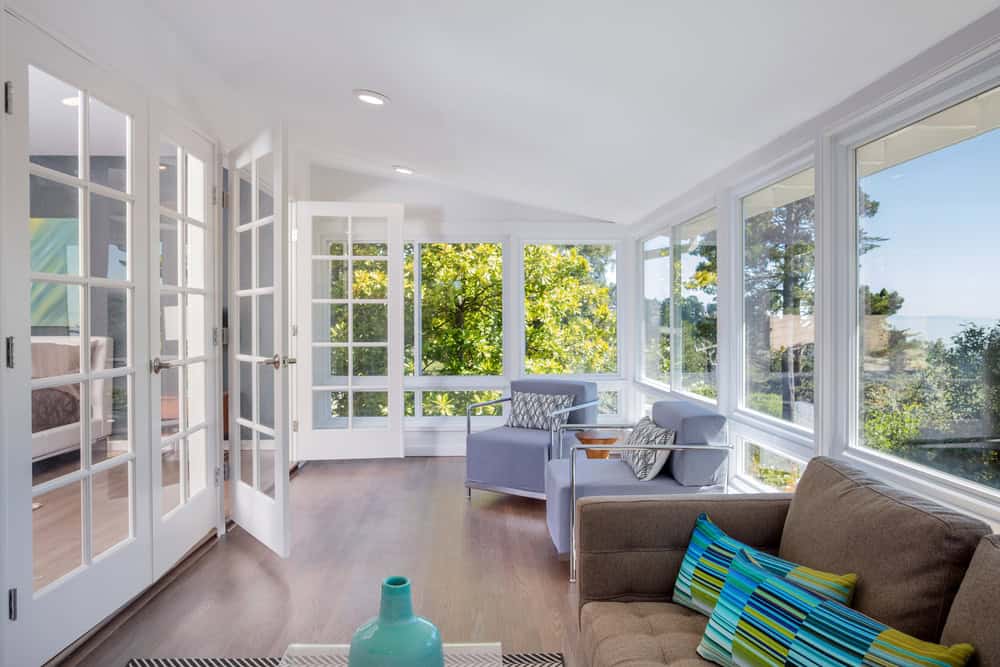
One of the most common questions we hear is whether adding a sunroom means replacing or upgrading the home’s entire HVAC system. Usually, the answer is no. Many Houston homes have systems with enough remaining capacity to extend service to a new sunroom, particularly for smaller additions in the 200 to 300 square foot range. When a home’s existing system is already running near capacity — which is common in older homes or in properties where the system was sized tightly — a dedicated mini-split unit is typically the better solution. Mini-splits are efficient, allow for zone-specific temperature control, and don’t put additional load on the main system.
What matters is that this gets assessed before construction starts, not after. Texas requires HVAC sizing to follow ACCA Manual J load calculations, which account for the room’s square footage, glass area, orientation, insulation values, and local climate data. In Harris County’s Climate Zone 2A, those calculations carry real weight — a room with the wrong system will struggle to stay comfortable on a 98°F afternoon no matter how well it’s built.
The glass system plays a significant role here too. We use CONSERVAGLASS™ NXT on our sunroom projects, which is engineered specifically to reduce solar heat gain and block UV rays without sacrificing natural light. In a market where the sun is intense year-round and air conditioning bills are already substantial, that performance difference is meaningful. A properly glazed, properly cooled 4-season room doesn’t have to spike your energy costs — in many cases, the heat-blocking properties of the glass offset the added cooling load more than most homeowners expect.
Yes — and this is one of the most important things to get right. Harris County and the City of Houston both require building permits for structural additions, including sunrooms. The permitting process involves plan review, structural inspections, and compliance with the Texas Residential Code and the International Energy Conservation Code. Skipping it isn’t a shortcut. It’s a liability.
Unpermitted sunrooms create real problems at resale. Title companies flag unpermitted structures, buyers’ inspectors identify them, and the resolution process — retroactive permitting or, in some cases, demolition — is expensive and disruptive. We’ve seen homeowners inherit this problem from a previous contractor and spend more fixing it than the original room cost. It’s a documented issue across the industry, not a rare edge case.
We pull every permit, meet every code requirement, and provide documentation at project completion. That’s not a bonus — it’s the baseline for doing this work correctly in Harris County.
It’s also worth noting that Houston is one of the few major U.S. cities without traditional zoning, but that doesn’t mean anything goes. Deed restrictions, setback requirements, and HOA covenants still govern what can be built and where. In master-planned communities like Cinco Ranch, Bridgeland, Riverstone, and Sienna — all of which have active architectural review committees — sunroom additions require HOA approval before construction begins. We’re familiar with that process and help clients navigate it as part of the project, not as an afterthought.
For most Houston homeowners, the 4-season room is the more practical long-term investment. The climate here simply doesn’t support the same cost-benefit math that makes a 3-season room a reasonable choice in other parts of the country. If you want a space you’ll actually use from January through December — not just during the brief comfortable windows in spring and fall — the 4-season room is where that becomes possible.
That said, every home and every budget is different. A well-designed 3-season room, oriented correctly and built with quality materials, can still be a worthwhile addition for the right homeowner with the right expectations.
If you’re trying to figure out which direction makes sense for your home specifically, we’ve been helping Harris County homeowners work through exactly this decision for years. Reach out and we’ll give you a straight answer — not a sales pitch.
Summary:
Article details:
Share: